
26
MayIn the high-stakes world of Indian FMCG, your distribution partner is much more than a logistics provider, they are the face of your brand to millions of retailers. In a landscape where a tiny distribution network gap can mean losing a customer to a competitor’s shelf space, the choice of partner becomes your most critical strategic lever.
From the high-tech aisles of urban hypermarkets to the cramped shelves of rural kirana stores, the Indian market is a logistical jigsaw puzzle. Navigating it requires more than just trucks; it requires a deep understanding of supply chain management India.
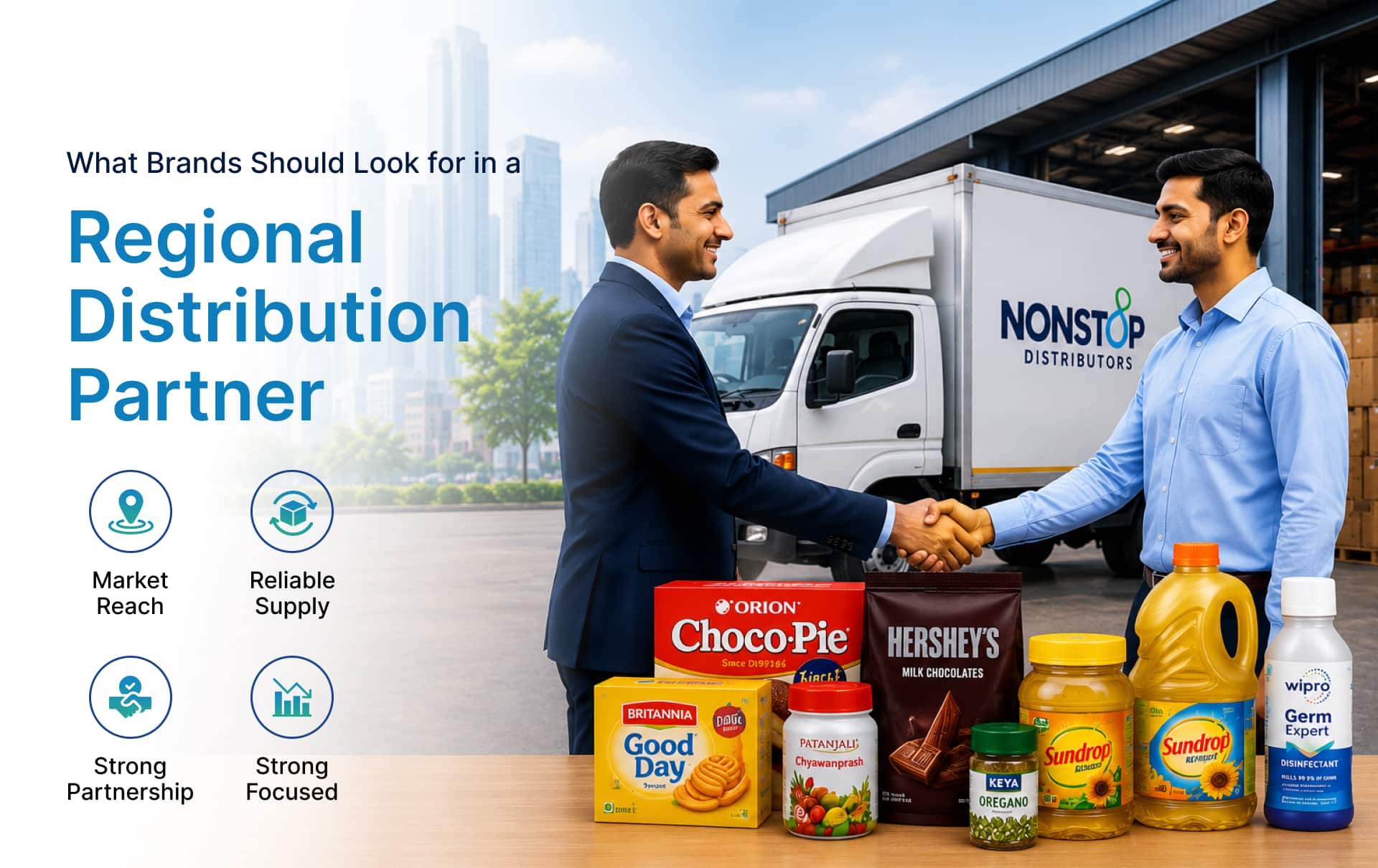
When evaluating FMCG distributors in India , brands often focus on fleet size. However, true market penetration comes down to three human-centric factors:
We are seeing a massive shift from traditional "godown" mentalities to sophisticated, tech-driven distribution management systems. Today’s leaders are integrating AI-driven demand forecasting with boots-on-the-ground execution. This hybrid approach is what separates a standard vendor from a true growth partner.
Think of your distribution partner not just as a middleman, but as the central nervous system of your brand's physical presence. In a market as fragmented and geographically diverse as India, "getting the product there" is only half the battle. The real challenge lies in distribution management—the art of balancing inventory levels so you’re never overstocked in a slow zone or sold out in a high-demand hub.
In the context of supply chain management India, the flow of goods is rarely a straight line. It is a complex web that demands precision at every hand-off:
The efficiency of your distribution network is a direct reflection of your partner’s operational health. Top-tier FMCG distributors in India don't just move boxes; they provide market intelligence which plays a key role in development. They understand the nuances of wholesale distribution, such as credit cycles and seasonal demand spikes which should not be forgotten.
When you optimize your retail supply chain, you aren't just cutting costs—you are building a competitive moat. A partner who masters distribution management ensures that your product is always within arm’s reach of the consumer, regardless of how remote the location might be.
In the Indian FMCG sector, your distribution partner isn't just an outsourced service; they are the custodian of your brand’s reputation. If a consumer walks into their local kirana store and doesn't find your product, they don't blame the truck driver; they buy your competitor.
In a market where traditional trade (the neighborhood kirana) still dictates the winner, your distribution network is the difference between a product that scales and one that sits gathering dust in a warehouse.
Choosing the wrong player among the sea of FMCG distributors in India creates a domino effect of failures. It’s not just about "delayed deliveries"; it’s about:
Conversely, when you align with a partner who understands the pulse of supply chain management India, you unlock a level of agility that competitors can't match.
A high-performing partner offers more than just logistics services India; they provide a gateway to:
Ultimately, your distribution network is the backbone of your expansion. In India, you don't just win on product quality; you win on availability. If you aren't on the shelf, you aren't in the game.
Choosing a distribution partner in the Indian market isn't just about who has the most trucks; it’s about who has the most influence. In a landscape defined by hyper-locality, your checklist needs to look beyond the surface level.
A partner’s distribution network is only as strong as its weakest link. In India, this means having deep-rooted access to not just urban malls, but the semi-urban and rural outlets that form the heart of consumption. You need a partner who doesn't just "know" the territory but has the trust of the local wholesalers.
Not every warehouse is built for the fast-paced nature of FMCG. You need FMCG distributors in India who understand "velocity." It’s an execution game, not just a storage game.
If the logistics fail, the brand fails. Evaluating supply chain management India means looking at their warehousing standards and route optimization. Top-tier logistics services India now utilize real-time tracking and automated dispatch to ensure the "last mile" is as efficient as the first.
The days of "pen and paper" bookkeeping are over. A modern partner must utilize a robust distribution management system. If they aren't using data to drive their sales analytics and inventory synchronization, your retail supply chain will always be reactive rather than proactive.
In wholesale distribution, credit is the oil that greases the wheels. Your partner needs the working capital strength to maintain healthy stock levels and manage the credit cycles common among Indian retailers. A financially strained distributor is a recipe for stockouts.
In India’s fragmented retail ecosystem, a distributor’s reputation with the local kirana store owner is your greatest asset. High-quality on-ground execution—regular visits, merchandising support, and reliable order collection—is what secures you prime shelf placement.
Can they grow with you? A true distribution partner should be able to scale their operations as you enter new territories. Beyond logistics, there must be a shared vision. They shouldn't just be moving your boxes; they should be championing your brand’s market positioning.
Trust is built on data. You need regular, transparent reporting to identify market gaps and optimize your strategy. Furthermore, in a complex regulatory environment, their operational discipline regarding tax and legal compliance is non-negotiable to protect your brand’s reputation.
The traditional "godown and truck" model is fading fast. In its place, we are seeing a high-tech, data-heavy revolution that is forcing every distribution partner to rethink their value proposition. If you are still looking at your distribution network through a 2010 lens, you’re already falling behind.
We’ve moved beyond simple record-keeping. Today’s top FMCG distributors in India are weaponizing data. By integrating AI and predictive analytics into their distribution management systems, they aren't just reacting to orders—they are predicting them. This reduces "dead stock" and ensures that capital isn't tied up in inventory that won't move.
In the old days, the sales team and the logistics team barely spoke. That’s a luxury brands can no longer afford. Modern supply chain management India now demands a unified front. When sales data from the field flows instantly into the retail supply chain backend, the response time drops from days to hours. Distribution has evolved from a back-office expense into a front-line growth engine.
The lines between wholesale distribution, modern trade, and e-commerce have totally vanished. Brands are no longer picking one path; they are using a hybrid approach which ic very crucial. A savvy distribution partner today must be capable of servicing a legacy kirana store one hour and a quick-commerce (Blinkit/Zepto) dark store the next. Flexibility is the new currency.
The real growth story isn't in the metros anymore; it’s in the "Rurban" and deep rural pockets. This is where logistics services India face their toughest test. Navigating the unique challenges of rural distribution network expansion requires localized partners who understand the cultural and logistical nuances of Tier 3 and Tier 4 towns.
Selecting a distribution partner is a long-term marriage. Unfortunately, many brands treat it like a short-term transaction, leading to "death by a thousand cuts" in their market share. If you want to build a resilient retail supply chain, you have to avoid these common industry traps.
The fastest way to kill a brand is to pick FMCG distributors in India based on who takes the smallest cut. It feels like a win on paper, but a "cheap" partner almost always lacks the actual backbone for real distribution management. You might think you’re saving 2% on your margins, but you’ll end up losing 20% in sales because your product isn't on the shelf when a customer actually wants it. Between frequent stockouts and damaged goods, a low-cost distribution partner is usually the most expensive mistake you can make.
If your partner is still running their wholesale distribution on manual entries and gut feelings, you’re headed for a disaster. In today’s market, manual records mean "ghost inventory," massive data lags, and zero clue where your money is tied up. You can't scale a business if you’re flying blind. Without a partner who uses modern logistics services India and integrated tech, your retail supply chain will always be one step behind. Scaling requires a distribution network that gives you real answers in real-time, not a "we'll check the ledger and get back to you" attitude.
Many distributors claim a massive distribution network, but when you dig deeper, their "active" reach is often much smaller. Brands often fail to verify if the distributor actually services the remote or "difficult" outlets that are crucial for total market dominance.
In the high-volume world of Indian FMCG, cash is king. Overlooking the financial health of your partner is a critical error. In supply chain management India, a partner with weak working capital will eventually struggle to stock your full range or extend the necessary credit to retailers, effectively bottlenecking your growth.
A partner might have the trucks and the cash, but if they don't share your brand's sense of urgency or ethics, the relationship will sour. Your distribution partner is an extension of your company; their lack of operational discipline becomes your brand’s reputation problem.
To round off this piece, we need to move away from the "sales brochure" tone and speak about Nonstop Distributors as a strategic ally. AI usually lists features; a human highlights the peace of mind and the competitive edge a specialized partner provides.
In an environment where every shelf-inch is a battleground, Nonstop Distributors isn't just another name on a vendor list— They are your strategic growth catalyst. Most FMCG distributors in India talk about "reach," but they leave you hanging when things get complicated. They have built a system that handles the friction so you don't have to:
A partnership with Nonstop Distributors is an investment in stability. They take the operational heavy lifting off your plate. This helps in allowing your team to focus on brand building while they handle the complexities of the distribution network which is very crucial. In the race for market share, they are the high-octane fuel your brand needs to cross the finish line first.
They are your eyes and ears on the ground. A distribution partner doesn't just deliver goods; they secure shelf space, manage local retailer credit, and provide the market intelligence needed to outpace competitors in a crowded retail supply chain.
It has shifted from "storage" to "velocity." Modern supply chain management India now relies on real-time data and automated distribution management to ensure products move faster, reducing "dead stock" and improving cash flow.
Fragmentation. Reaching deep rural pockets requires a distribution network that can handle small-drop sizes and frequent visits. Top FMCG distributors in India succeed here by building high-trust relationships with village-level wholesalers.
Because "Physical is King" in India. Wholesale distribution provides the massive scale and credit support that e- commerce cannot yet replicate for millions of independent kirana stores across the country.
Speed-to-market is everything. Efficient logistics services India minimize delays and damages. When your distribution management is tech-enabled, you can scale into new territories without the logistical "growing pains" that typically sink expanding brands.
Rahul Nandanwar
LinkedInRahul Nandanwar is the Co-founder of Nonstop Distributors, a premier FMCG distribution network servicing Nagpur and its surrounding districts.Leveraging years of corporate experience in territory sales and marketing with global brands, Rahul drives the strategic growth and operational excellence of Nonstop Distributors.He is passionate about optimizing supply chains, forging strong retail partnerships, and sharing industry insights.